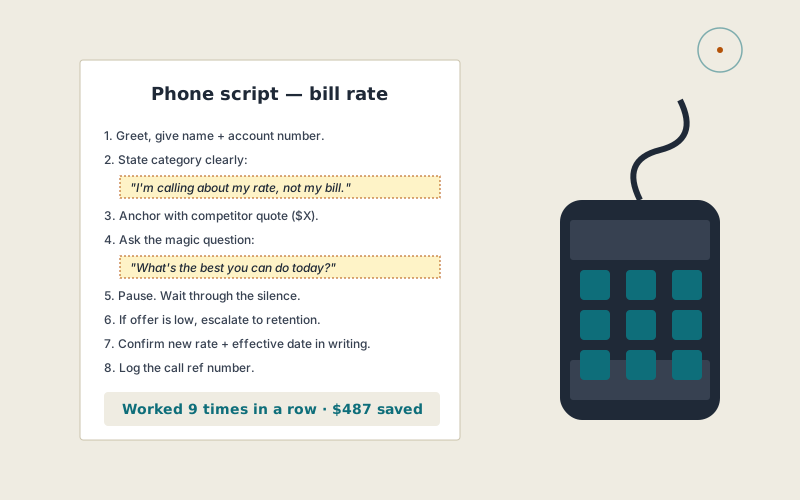
This is the exact phone script we use when we call to negotiate a recurring bill — internet, mobile, home alarm, gym, anything where the same provider has been billing us for more than a year. We've used variants of it nine times in the last three years. It has worked nine times. The lifetime savings across those nine calls is around $487.
None of these phrases are clever. The script is mostly about discipline: doing the prep, asking specific questions, and shutting up during the silence. We're publishing it line-by-line, including the awkward bits we used to talk over.
Prep — before you dial
The single biggest predictor of whether a negotiation call succeeds is whether you walked in with leverage. Five things, none of them complicated:
- One competitor's offer, in writing. Screenshot or PDF. Specific plan, specific price, specific install timeline. Doesn't have to be the cheapest — has to be credible.
- Your current bill open on a second tab. Account number, monthly charge, contract end date.
- The exact dollar amount you want to land at. Not "lower." A number.
- Your "I'll switch" line. A short, true sentence about what you'll do if the answer is no.
- 30–45 minutes blocked. Most successful calls end in 15 minutes. The fastest path to a bad outcome is a rushed call where you accept the first offer to get off the phone.
The script
1. Open with the operator
You: "Hi, I'd like to talk about my rate on my account. Account number is [number]."
Notice the wording: "my rate." Not "my bill" — bills go to billing, which can't change pricing. Not "my plan" — that routes to sales, which loves to upsell. "Rate" reliably routes to customer retention or loyalty.
2. Verify you're with the right person
You: "Before we start — are you able to adjust the rate on this account, or do I need to talk to someone in retention or loyalty?"
This is a generous question to ask. It saves you from spending 12 minutes negotiating with someone who literally cannot give you a discount. Most reps will tell you the truth.
3. State the situation
You: "I've been a customer since [year]. I'm currently paying $[X] a month. I've been looking at what's available, and I have a written offer from [competitor] for $[Y] for [equivalent service]."
Plain. Factual. No drama. You haven't asked for anything yet.
4. Ask the magic question
You: "What's the best you can do today?"
That's it. Don't add a deadline. Don't add a justification. Don't apologize for asking. The question is small and the answer is the entire negotiation.
5. The silence
This is the hardest part. The rep will pause. Sometimes for 20–40 seconds. Do not fill the silence. Do not say "if it helps, I just need to get below $80" or "I know times are tough." You said your number, you asked your question, you wait. Most of the dollars you're about to save come from this silence.
6. Evaluate the first offer
The first offer is almost never the best offer. Listen for whether it's a one-time credit (low value), a multi-month promo discount (medium value), or a permanent rate change (high value). Multi-month promos quietly revert; ask if it does.
You: "Just so I understand — is that a temporary promotion or my new rate? When does it expire?"
7. Counter if it's not enough
You: "I appreciate that. The number I need to see to stay with you is $[your target]. Can you do that?"
Or, if the offer is a temporary promo:
You: "Can you make that the permanent rate rather than a 12-month promotion?"
8. Escalate if the front-line can't
You: "I think we're close. Is there someone in retention or loyalty who has more flexibility on this account?"
That sentence has been load-bearing for us. About half our successful negotiations crossed the finish line only after this transfer. The front-line script has limits; retention's script has fewer limits.
9. The "I'll switch" line
Only if you mean it: "If we can't get to [target], I'll need to start the port to [competitor] this week. I'd rather not, but the math is the math."
Bluffing rarely helps. Reps see your account history; they know whether you're a likely-flight risk. The line works because you have the competitor quote already pulled.
10. Close
If you have a deal, lock it in:
You: "Just confirming the new rate is $[X] per month, effective on the next billing cycle, with no change to my services and no contract extension. Can you email me a confirmation with that, and can I have a reference number for this call?"
If you don't have a deal:
You: "Thanks for your time. I'll think it over and decide by [date]. Have a good one."
Hanging up politely is a real option. We've twice gotten a callback within 48 hours with a better offer because the carrier flagged the account as flight-risk.
What works, what doesn't
Nine calls, summarized
- Internet provider, twice — $15/mo and $20/mo permanent reductions.
- Mobile, three times across three years — $14/mo, $24/mo, and $8/mo.
- Home alarm monitoring, once — $12/mo permanent reduction.
- Gym membership, twice — $8/mo loyalty rate, then a frozen-month credit.
- Auto insurance, once — small mid-term discount; we switched fully later anyway.
Cumulative monthly impact at the time of each call: roughly $101/mo combined. Annualized that's $1,212; smoothed over the actual durations of those discounts and natural rate creep over time, the durable lifetime savings is around $487. Not life-changing — but well above $0 per phone call we used to never make.
The one thing we'd say if you call only once
Don't call without a competitor quote in hand. The whole script depends on having external leverage. If your competitor research takes 20 minutes and your call takes 15, you'll consistently end at "yes" rather than "we'll review and call you back." The prep is the script.