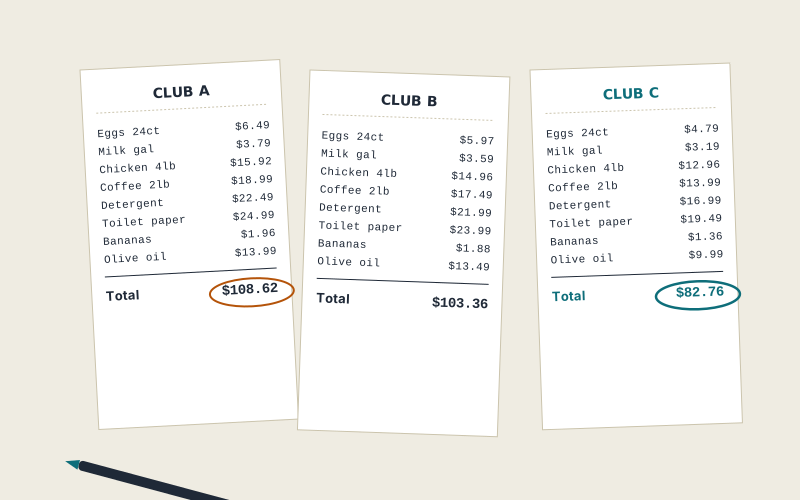
For twelve months we ran the same 22-item grocery list at three stores: Costco, Sam's Club, and Aldi. Same week, same items, same day-of-week if we could swing it. We kept every receipt. We're a household of four — two adults, two kids — and we shop weekly. We're not a single-occupancy shopper who can't possibly use a flat of 60 eggs; we're not feeding a youth-football team either. Average household, average appetite, average freezer.
What we found will not surprise anyone who has spent serious time inside an Aldi. What will surprise some is where the warehouse clubs actually do win, even after you back out the membership fee.
The setup
The list:
- Pantry staples — flour, sugar, olive oil, canned tomatoes, peanut butter, coffee, pasta, rice
- Dairy — milk, eggs, butter, shredded cheese, yogurt
- Proteins — chicken thighs, ground beef, sliced deli turkey, bacon
- Produce — bananas, apples, baby spinach, onions
- Household — laundry detergent, toilet paper
We adjusted unit sizes to make per-unit math comparable. (You can't buy a single can of tomatoes at a warehouse club, so we compared $/can on a normalized basis.) We tracked total weekly spend, per-item unit price, and a quality score from 1–5 on the items where quality genuinely varies (deli meat, dairy, produce).
Top-line numbers
Average weekly spend on the standard list, across 12 months:
- Costco: $108.62
- Sam's Club: $103.36
- Aldi: $82.76
Annualized at 52 weeks:
- Costco: $5,648
- Sam's Club: $5,375
- Aldi: $4,304
Membership fees backed in (Costco Gold Star $65/yr, Sam's Club Club $50/yr, Aldi $0):
- Costco: $5,713
- Sam's Club: $5,425
- Aldi: $4,304
Aldi wins by $1,121–$1,409 a year on the same list. That is not close.
Where Aldi crushes
Store-brand staples. Aldi's private-label pantry items consistently beat both warehouse clubs on per-unit price, often by 20–30%, with quality that's comparable for everything in our list except two items (we'll get to those). Specific categories where Aldi was meaningfully cheapest in our data:
- Eggs, milk, butter
- Bread, pasta, rice
- Frozen vegetables
- Canned goods
- Bananas, apples, basic produce
This is the boring middle of a grocery cart — the items you actually buy every week — and Aldi was cheapest on essentially all of them.
Where the warehouse clubs actually win
Even though Aldi wins on total, the warehouse clubs win specific categories convincingly enough that for many households the answer is "both."
1. Bulk proteins
Both Costco and Sam's Club consistently beat Aldi on per-pound bulk proteins — chicken thighs, ground beef, salmon. The catch is the pack size. A 6-lb pack of chicken thighs at Costco at $2.49/lb beats Aldi's 2-lb pack at $3.49/lb, but only if you'll actually use 6 lb before freezer burn or boredom. For us, we use the freezer aggressively, so this works. For an apartment shopper without a deep freeze, the saving disappears.
2. Olive oil, nuts, dried fruit
These are the warehouse clubs' classic stronghold and the data confirmed it. Costco's house-brand olive oil in the 2-L size beat Aldi's per-mL price by about 22%. Almonds: same story. Sam's Club was a hair behind Costco on these.
3. Specific brand items the clubs price-cut aggressively
Both clubs run rotating member-only deals on brand-name items (specific coffees, certain detergent brands, name-brand cheese). When these line up with our shopping cycle they were the cheapest per unit anywhere — but they're inconsistent.
4. Quality jumps in two categories
We rated quality higher at the warehouse clubs in two categories: rotisserie chicken (Costco's notoriously priced loss-leader) and bakery bread (both clubs). If those are a meaningful part of your weekly diet, the calculus shifts.
The membership math
A Costco Gold Star is $65/year. A Sam's Club Club is $50/year. To break even on either, you need to save $65 or $50 versus your next-best option. We did. Comfortably. The membership question is really: "Do I shop here often enough to use the cards?" If you go once or twice a quarter for a specific category — say, olive oil and chicken — you'll still beat the fee. If you only go on impulse and end up with a $19 sweater you didn't need, the membership is the cheap part of the problem.
What we landed on
After 12 months we settled on a two-store hybrid:
- Weekly Aldi run — pantry staples, dairy, produce, household basics, frozen vegetables. Our default cart.
- Monthly warehouse-club run — bulk proteins for the freezer, olive oil, nuts, the specific brand items we like, occasional rotisserie chicken. We kept one club membership and dropped the other.
Annual cost on that hybrid model, tracked across a separate 3-month period: $4,512. That's an additional $200 below pure-Aldi because the warehouse-club run picks up the categories where the club is cheaper. After backing out the membership fee, net annual cost is about $4,577.
So the all-in winner against the original $5,648 Costco-only baseline is a hybrid model that saves $1,071 a year, without giving up any of the bulk-protein and pantry-staple wins.
Things we left on the table
- Other discount chains. Lidl, Trader Joe's, regional discount chains. We didn't have all three on the road network we drive, so we kept the comparison clean to the big three.
- Pharmacy prices. Costco's pharmacy is famously cheap for cash prices on common generics. We didn't include it because our prescriptions go through insurance.
- Gas. Costco's gas usually beats local prices by $0.10–$0.20/gallon. We didn't include it because we don't use it weekly.
Each of those would push the warehouse clubs slightly toward the winning column if added in.
Bottom line
On a pure-grocery basket, Aldi is meaningfully cheaper than both warehouse clubs. On bulk proteins, pantry oils, and nuts, the warehouse clubs are cheaper than Aldi. The household-optimal strategy is almost always a hybrid, with Aldi as the weekly default and one warehouse-club run a month for the categories where the club genuinely wins. Save the second club membership for the year you can prove you'd use it.